// FEATURED BOOK
Second Edition · Packt
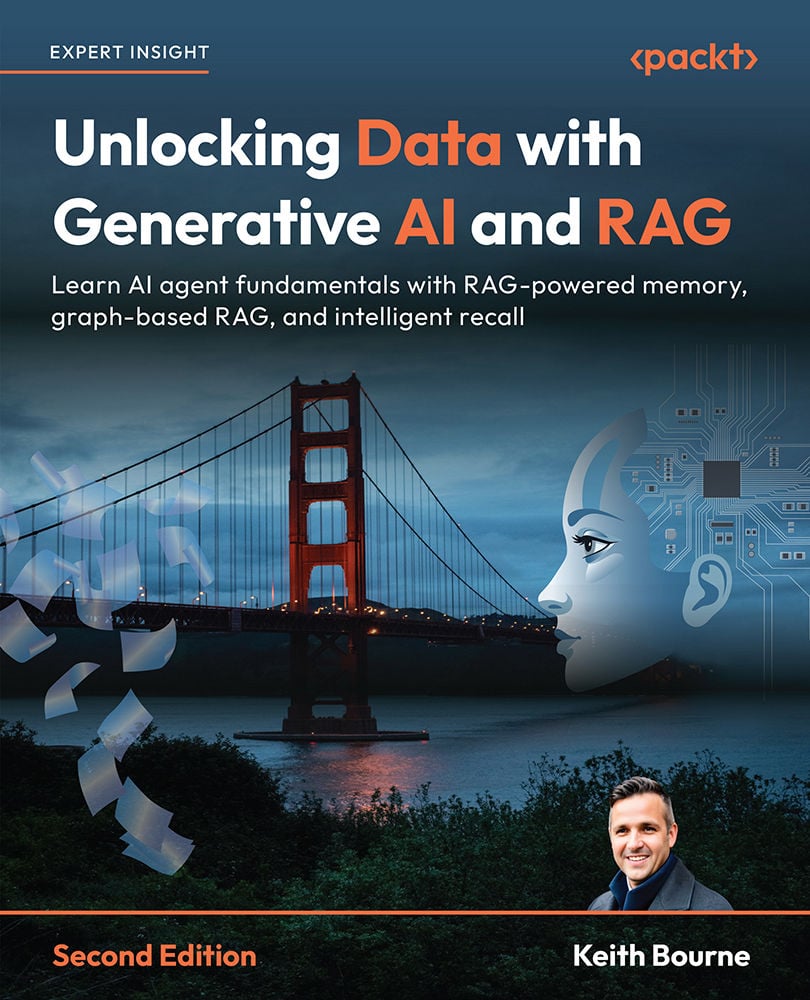
Unlocking Data with Generative AI and RAG
Learn AI agent fundamentals with RAG-powered memory, graph-based RAG, and intelligent recall.
By Keith Bourne · Paperback + DRM-free PDF
★★★★★5.0(9 ratings)#1 Best SellerNetwork Storage & Retrieval Administration
// THE FOUNDATION MEMRIQ IS BUILT ON
The concepts in this book are the foundation on which the entire Memriq system was built — agents with RAG-powered memory that continually learn and improve, reaching levels of capability traditional engineering can't approach. The book gives you the RAG foundation, then carries it into in-depth chapters on using that foundation to build some of the most advanced agents in the world.
Read the book, then see it running in production across the Memriq conglomerate.
Developing AI agents that remember, adapt, and reason over complex knowledge is happening now with Retrieval-Augmented Generation. This bestselling second edition takes you to the forefront of agentic system design — intelligent, explainable, context-aware applications powered by RAG pipelines: agentic memory (semantic caches, procedural learning with LangMem, and the CoALA cognitive-agent framework), GraphRAG with Neo4j and ontologies, and working, episodic, semantic, and procedural memory with vector stores and feedback loops for systems that continuously learn.
Key features
- →Build next-gen AI systems using agent memory, semantic caches, and LangMem
- →Implement graph-based retrieval pipelines with ontologies and vector search
- →Create intelligent, self-improving AI agents with agentic memory architectures
What you'll learn
- →Architect graph-powered RAG agents with ontology-driven knowledge bases
- →Code memory pipelines for working, episodic, semantic, and procedural recall
- →Implement agentic learning using LangMem and prompt-optimization strategies
- →Integrate retrieval, generation, and consolidation for self-improving agents
- →Build semantic caches to improve response speed and reduce hallucinations
- →Design caching and memory schemas for scalable, adaptive AI systems
- →Use Neo4j, LangChain, and vector databases in production-ready RAG pipelines
The arc — foundation to advanced Ch 1–11
Foundation
What RAG is, a full RAG pipeline and its components, security, vectors and vector stores, similarity search, evaluation, and LangChain.
Ch 12–14
Agents & Graphs
RAG with AI agents and LangGraph, ontology-based knowledge engineering, and Graph-Based RAG over a knowledge graph.
Ch 15–19
Agentic Memory
Semantic caches; agentic memory that extends RAG with stateful intelligence; RAG-based agentic memory in code; procedural memory with LangMem; and advanced RAG with complete memory integration.
Memriq runs these in production